


I Ran My Hydro Pump Dry, How Do I Check for Damage?
Once a hydro pump has run with its jets above the water, Ella's published guides do not offer a visual inspection that tells you whether it survived. A pump is built to move water, not air, so running it before water covers its jets can permanently damage it, and that damage is not covered. The check the guides point to is one controlled test run with the tub filled correctly, so the place to begin is What Is the Water Line Before Running the Jets on a Walk-In Tub?, which sets the fill level that test depends on.
What a Dry Run Does to the Pump
Every jetted Ella tub follows the same rule: a pump must not run until water covers every jet it serves. Hydro jets sit at several heights in the shell, so the pump on a hydro massage tub is not safe to start until the highest hydro jet is 1 to 2 inches under water. Ella's operation video uses 2 inches. Air jets sit low by the feet and up on the seat, so air massage needs a full-tub fill, and a microbubble system needs water over both the port and the intake before the Micro button is pressed.
When a pump starts with jets exposed it is trying to move air instead of water. Ella's guidance is consistent across every guide that touches the subject: a pump that runs without water above all the jets is permanently damaged, and that damage is not covered. That is why the first job after a dry run is not diagnosis but prevention. Whatever caused the pump to run has to be found before power goes back on, or the same thing happens again during the test.
First, Make Sure It Cannot Run Dry Again
If the pump is still running, or started on its own, cut power before anything else. Unplug the tub and leave it unplugged until the cause is found, or turn the circuit off at the breaker. Flipping the breaker is the correct interim step whenever a pump or blower keeps running, as explained in Why Won't the Air or Pump Shut Off, and Is Flipping the Breaker Okay?. Then work through the reasons a pump runs when nobody has asked it to:
- A pump cord in the wrong socket. On an Ella tub the water pump and air pump cords plug into labeled ports on the control box, and the control box is what plugs into the dedicated GFCI outlet. A pump plugged straight into a wall outlet or a splitter has no switch in front of it, so it runs the moment the circuit is live. This one mix-up explains most reports of a motor starting during installation, and Why Does the Pump Turn On as Soon as the Tub Is Plugged In? walks through the cord check port by port.
- A deck button stuck down. Each push button sends air down a tube to a relay switch in the control box, and an air lock in that tube can hold the signal on. If a button is sitting down and will not pop up, pull its air tube off the nipple at the control box, let the button pop up, then push the tube firmly back on. The video on this page shows a technician at the relay switch doing exactly that: disconnecting the air tube, letting the line relieve itself, and reconnecting it.
- A control box fault. If the cords and buttons are right and the pump still starts on its own, the remaining suspect is a relay stuck closed or a box that has lost its configuration. The control box reset is the next step, and the team confirms a box fault from photos once the cord and button checks are done.
- A partial fill on a shared pump. On tubs without Independent Foot Massage the foot jets and the seat jets share one pump. Filling only the footwell and pressing the hydro button leaves the upper jets exposed and the pump running dry. How Do I Use Only the Foot Massage Without Filling the Whole Tub? explains how to tell which package you have.
The Controlled Test Run
With the cause corrected, the test is the same routine you would follow for any bath, done deliberately:
- Step in, close the door and close both drains.
- Fill the tub. For hydro massage, keep filling until the highest hydro jet is 1 to 2 inches under water. For air massage every air jet must be submerged. Never fill above the center of the drain handle, which is the overflow line.
- Restore power to the tub.
- Press the hydro button once. You should hear a click inside the control box as the relay engages, and the pump should start.
- Press the button a second time. The pump should stop.
- Switch every pump off before you open the drains, so the pump never runs as the water drops below the jets.
Three outcomes are possible. If the pump starts on the first press, moves water through the jets and stops on the second press, you have the best evidence available that it is working. If the pump hums but does not move water, or does nothing at all, the first thing Ella's guides ask you to confirm is the water level, and once the level is right a pump that still hums or stays silent needs a ticket. If the pump starts on its own again before you touch the button, go back to the cord and button checks above, because the cause has not been found.
What to Send with Your Ticket
Ella does not send technicians. Replacement parts ship under the warranty after the team has verified the problem, and a local licensed plumber or electrician does the labor. The team's decision on a pump that ran dry rests on the record you send, so gather it before you call:
- Your model and serial number.
- Your therapy package, which is on your order and tells the team which pumps your tub has.
- How full the tub was when the pump started.
- A photo of the control cluster on the deck and, if you can reach it, a photo of the pumps and the control box behind the access panel, showing where each cord is plugged in.
- What happened during the test run: started and stopped on the button, hummed, did nothing, or started on its own.
Open the ticket at ellasbubbles.com/support or call (800) 480-6850. Because Ella's published position is that dry-run damage is not covered, be straightforward about what happened. The team confirms the cause from your photos, and if the pump started because of a cord plugged into the wall or a stuck button, say so, since correcting it protects whatever pump runs in the tub next.
Two Things That Are Not Dry-Run Damage
Two sights worry owners for no reason. The first is water in the jet lines of a brand-new tub. Every Ella tub is filled and run before it ships to verify every plumbing connection, and it is slightly overfilled during that test, so water left in the lines, the drain body or the bottom of the crate is expected. Water in the Lines or the Crate of a New Walk-In Tub Is Normal explains what the factory test covers. The second is a burst of air from the air jets about 20 minutes after you turn the air massage off. That is the automatic purge, which runs for 120 seconds to blow residual water out of the air lines, stops on its own, and is normal even if you are still in the tub. A blower that keeps running past that, or a purge that repeats when the air massage has not been used again, is a control box problem and belongs in the button and reset checks above.
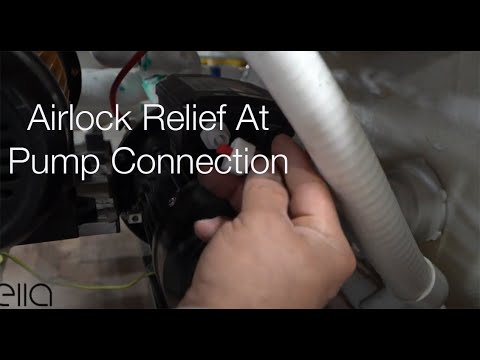
Watch: Ella's Bubbles: Relieving Air Lock at the pump connection with chapters and a full transcript.
Related Guides
- What the Hydro Massage Schematic Shows: One Pump, the In-Line Heater in the Jet Loop, Ozone and One Dedicated Line
- Hydro Pump Only Hums After a Repair: Why an Empty Tub Shows Nothing
- Pump or Massage System Not Working: Connections, Relay Switch, and What to Check First
Common Questions
Can I tell by looking at the pump whether running it dry damaged it?
Is a pump that ran dry covered by the lifetime parts warranty?
My pump only ran dry for a few seconds, is it fine?
Why did my pump start the moment I plugged the tub in?
Should I switch the jets off before I open the drains?
Does the air blower running after my bath mean it is running dry?
About this guide. Answers in the Ella’s Bubbles Support Center are compiled from real conversations with tub owners, our technicians’ notes and the product documentation, then reviewed by our team. Tub models and options have evolved over the years, so a detail here may differ slightly from your exact tub. If something looks different on yours, send us your serial number and a specialist will confirm it for your model.
Did this solve your question?
If not, open a ticket and our team will pick it up from here.
Open a Support Ticket Videos