


Do walk-in tub doors leak, and which door seals are most reliable?
Updated October 2026
Ella walk-in tub doors are designed not to leak, and in practice the seal rarely fails. Every Ella door, inward-swing or outward-swing, closes against a silicone gasket; the outward-swing doors add a gear and shaft driven 3-latch lock that puts equal pressure on the gasket all the way around, while inward-swing doors get extra help from the water itself pressing the door into the seal as the tub fills. When water does appear at the door, the cause is almost always a tub that is no longer level or residue on the gasket, as Common Questions About Walk-In Tub Door Seals explains, so the most reliable seal has less to do with door style than with leveling and care.
Do Walk-In Tub Doors Leak?
Not when the tub is installed and used as intended. The door seal, also called the door gasket, is the soft silicone strip around the door opening. When you close and lock the door, the gasket compresses against the frame into a watertight seal. Your installer confirms that seal after a 20 minute fill as part of the warranty activation checklist, so a tub that leaves installation day dry has a proven seal. Reports of a "bad seal" nearly always turn out to be one of three things: residue on the gasket, a seal that has been pushed out of its groove, or a leveling leg that is no longer firmly on the floor. All three are fixable at home. What Is the Door Seal on a Walk-In Tub? describes the part itself; this page compares how the different doors hold it.
Which Door Seal Is Most Reliable?
Ella offers five door styles, and the video on this page walks through all of them: the inward-swing U-shaped door, the outward-swing U-shaped door, the L-shaped outward-swing door, the Ultra inward-swing door and the Standard S-shaped inward-swing door. Each uses its own seal size, but they all seal in one of two ways. Outward doors are pulled into the gasket by the latch mechanism alone, which is why Ella uses three latches on a proprietary gear and shaft rather than the single latch other walk-in manufacturers use. Inward doors are pulled in by the latch and then pressed harder into the gasket by the water as the tub fills, which is also why an inward door will not open until the tub has drained.
| Door style | Construction in the sources | Lock and clearance | How the seal is held |
|---|---|---|---|
| Outward-swing U-shaped | White composite frame with a tempered glass panel, three latches | Chrome locking handle, gear and shaft 3-latch; 20 inch opening swing clearance | Equal pressure on the gasket all the way around from the three latches |
| Outward-swing L-shaped | Extra wide opening, handle on the front, fits over a standard size toilet | Gear and shaft 3-latch; 36 1/2 inches of clearance | Equal pressure on the gasket from the three latches |
| Inward-swing U-shaped | Brushed stainless steel with a tempered frosted glass panel, removable for cleaning | Interior chrome locking handle; clearance not listed | Latch plus water pressure as the tub fills |
| Ultra inward-swing | Brushed aluminum, removable | Not listed | Latch plus water pressure as the tub fills |
| Standard S-shaped inward-swing | Acrylic S-shape door | Not listed | Latch plus water pressure as the tub fills |
What the table means for you is that there is no weak seal in the lineup to avoid. If your bathroom has room for the 20 inch outward swing, the three-latch gear and shaft doors give you a seal that does not depend on water depth and an entry with no knee clearance to step over, which is why they are the easier choice from a wheelchair. If space is tight, the inward doors are just as watertight and gain pressure as the water rises, at the cost of waiting for the tub to drain before the door opens. Both families carry the same Lifetime Limited Warranty on the door and the seal. If your leak is at a glass shower screen beside the tub rather than at the door, that gasket is a different part, covered in How Reliable Is a Walk-In Tub With a Glass Shower Wall?.
What Actually Decides Whether a Seal Stays Dry
- A level tub. Leveling is the number one cause of door leaks. Ella tubs have at least six leveling legs, and every leg must rest solidly on the floor with equal weight. A leg that has lifted lets the shell flex enough to open a gap at the gasket, usually on the lower handle side.
- A clean seal and frame. Soap film, hair or grit sitting between the gasket and the frame is a very common cause of a slow drip. Wipe both with rubbing alcohol or a common household cleaner, never abrasives.
- The ajar rule. Leave the door slightly open or unlocked whenever the tub is idle so the gasket is not under constant compression. A door kept closed all the time can weaken the seal over time, and it is one of the first things the team asks about on any leak report.
- No weight on the door. Never lean on the door or use it as a handhold. The warranty on the door and seal depends on the alignment staying as it was set at installation and not being changed by a bather's weight on the door.
- A correctly tensioned handle. If you have to force the handle, or the handle moves easily but the door never pulls into the seal, the handle lock nut behind the front apron needs adjusting, not the hinges. How Do I Adjust the Door Latch So the Door Seals Without Forcing? covers it step by step.
If You See Water at the Door
- If the door has been kept shut, leave it open for about a day, or at least overnight, so the seal can reform, then fill the tub and check the gasket line. Many leaks clear up with this step alone.
- Wipe the gasket and the door frame clean.
- If the gasket looks flattened, stuck or deformed, squeeze it gently between your fingertips and pull it slightly away from the frame to restore its shape. New seals sometimes arrive this way from shipping, and the same fix applies.
- If part of the gasket has popped out of its channel, press it back in along its full length. A gasket that keeps working out can be secured with a thin bead of silicone in the channel.
- Check every leveling leg for a gap beneath it, and inspect the full loop of the gasket, since a drip in one spot is often caused by grit or a lifted section somewhere else.
- Check the handle. It should sit flush to the inside of the tub, and on outward doors it faces away from the hinges when unlocked and toward the hinges when locked.
Warranty and Replacement Seals
The door and door seal are covered for defects under the Lifetime Limited Warranty, parts only, provided the tub and door were aligned correctly and the alignment has not been changed by putting a bather's weight on the door. There is no scheduled replacement interval. When a replacement is warranted, the team ships a model-specific seal matched to your serial number after a support ticket with clear photos of the seal and the leak point, so have those ready and note whether all leveling legs touch the floor. Ella does not send technicians; a local licensed plumber or installer does any leveling or fitting, and the support team can answer their questions by phone, email or video. Seals from other makers will not fit an Ella door, and Ella seals will not fit another brand's tub, as My Tub Is a Different Brand. Will Ella's Bubbles Parts Fit? explains. Open a ticket at ellasbubbles.com/support or call (800) 480-6850.
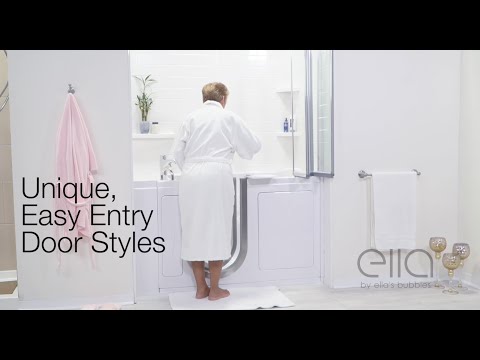
Chapters in this video
- 0:00 Five Unique Door Styles Ella's Bubbles offers five distinct low-threshold door styles for easy entry into their walk-in tubs.
- 0:27 Outward Swing Door Features Outward swing doors provide easier entry and exit, featuring a decorative glass panel and a chrome locking handle.
- 0:39 Inward Swing Door Details Inward swing U-shaped doors are made of brushed stainless steel with frosted glass and are removable for cleaning.
- 1:02 L-Shaped Door Accessibility The L-shaped door offers an extra-wide opening for easy access, accommodating wheelchair users and fitting over a toilet.
- 1:17 Leak-Proof Locking Mechanism Outward swing L-shaped and U-shaped doors feature a proprietary gear and shaft locking mechanism for a tight, leak-proof seal.
Watch: Pick the Perfect Walk-In Tub Door: 5 Elegant Door Options | Ella’s Bubbles with chapters and a full transcript.
Related Guides
- Caring for Your Door Seal: Cleaning, Reseating, and Replacing the Gasket
- Water at the Door: What to Check First and Why You Should Never Lean on the Door
Related Videos

Chapters in this video
- 0:00 Clean Your Door Seal Regularly The video explains how to clean the door seal and frame to prevent leaks and debris buildup.
- 0:38 Replacing a Loose Door Seal The video demonstrates how to replace a loose or damaged door seal by applying a thin bead of silicone to the gasket channel.
- 1:02 Adding Silicone to Inward Doors The video shows how to add a bead of silicone to the corner of the gasket where it meets the frame on inward swing doors.
- 1:23 Extend Gasket Life The video recommends leaving the walk-in tub door slightly open when not in use to extend the gasket's flexibility and life.

Chapters in this video
- 0:00 Outward Swing Door Design The video introduces the robust vault-like design of Ella's Bubbles outward swing walk-in tub doors, featuring oversized tapered pins for a secure seal.
- 1:26 Easy Door Operation The video demonstrates how easy it is to close and operate the outward swing door, highlighting the tapered pins that do all the work.
- 2:01 Accessibility and Peace of Mind The door is designed for ease of use, even with limited mobility, providing maximum peace of mind that the seal will never leak.
Common Questions
Do Ella walk-in tub doors leak with normal use?
Which Ella door style has the most reliable seal?
Why does my door leak only at the bottom corner?
Should I leave the walk-in tub door open between baths?
Is the door seal covered by the Ella warranty?
Can I use a door seal from another walk-in tub brand?
About this guide. Answers in the Ella’s Bubbles Support Center are compiled from real conversations with tub owners, our technicians’ notes and the product documentation, then reviewed by our team. Tub models and options have evolved over the years, so a detail here may differ slightly from your exact tub. If something looks different on yours, send us your serial number and a specialist will confirm it for your model.
Did this solve your question?
If not, open a ticket and our team will pick it up from here.
Open a Support Ticket Videos