


What Is a Roll-In Shower and How Does It Differ From a Transfer Shower?
A roll-in shower is a curb-less shower built on a barrier-free base, so a wheelchair or shower chair rolls straight in with nothing to lift a wheel over, and a flexible rubber dam rather than a curb keeps the water inside. A transfer shower is a compartment with a low threshold and a built-in seat: the bather parks a wheelchair alongside, crosses the low step and moves onto the seat rather than staying in the chair. Ella's roll-in base is set against a walk-in tub in What is the difference between a walk-in tub and a roll-in shower?; this page sets the two shower types against each other and explains how each is built.
What Makes a Shower Roll-In
Ella's wheelchair accessible roll-in base is a curb-less acrylic pan. It comes in three standard sizes, 30 x 60, 32 x 60 and 36 x 60 inches, with the drain position specified when you order, and sizes outside those can be made to order. The 32 by 60 inch base is offered in left and right drain versions and is ready to ship. AcrylX barrier-free bases have a beveled roll-in entry of 3/4 inch to 1 1/8 inch depending on size, and SMC bases are 1 inch or 1 1/8 inch, the lowest entry of any Ella product. ADA standards generally limit the threshold in a roll-in compartment to 1/2 inch, and your local building department decides what passes inspection, so confirm that locally before anything is ordered.
Because there is no curb, water is held in by the Ella flexible shower dam, a compressible waterproof strip bonded along the open edge of the pan. The wheels roll over it on the way in and out and it returns to its shape. The first video shows it installed: the surface is cleaned with denatured alcohol, a tape line is laid as a guide, the dam is cut to length and capped at each end, the tape backing is peeled away as the dam is pressed snug against the wall and floor, and a thin bead of silicone is run along both lower edges and over the end caps. The video then shows the dam compressing under a chair's wheels and springing back to hold the water in the stall.
A seat is optional on a roll-in shower, and that is the heart of the difference from a transfer shower. Folding benches and seats rated from 300 to 600 pounds can be added, or the 36 by 60 base can be ordered with a molded seat. Caregiver options include a weighted anti-bacterial nylon curtain, a stainless curtain rod and a slide bar with hand shower.
What Makes a Shower a Transfer Shower
In a transfer shower the bather does not stay in the wheelchair. The chair is parked beside a low threshold and the bather transfers sideways onto a seat built into the compartment. Ella's version is the 60 by 36 one-piece ADA Transfer Shower Stall Kit, an acrylic unit measuring 60 by 36 by 77 inches with a 4 inch high threshold, a right hand seat and a left drain. The 4 inch threshold is the same height as Ella's other one-piece and three-piece stalls, and it is what keeps the water in, so no dam is used. The trade is simple: a transfer stall gives a fixed seat and a conventional threshold, while a roll-in base gives nothing to cross and leaves the seat to you.
Do not confuse the transfer shower with Ella's Transfer walk-in tubs. Those are tubs with an extra wide L-shaped outward-swing door that fits over the toilet so a bather can transfer from a wheelchair to the tub seat, close a two-latch gear and shaft lock and fill the tub for a soak. The second video shows that tub, its door and its dual drains, and it belongs in the tub conversation rather than the shower one.
Roll-In, Transfer and Step-In Options Side by Side
| Option | Entry or threshold | Sizes in the sources | Seat | Best for |
|---|---|---|---|---|
| AcrylX barrier-free roll-in base | Beveled roll-in entry of 3/4 inch to 1 1/8 inch depending on size, with flexible dam | 30 x 60, 32 x 60 and 36 x 60 inches; other sizes made to order | Optional folding seat rated 300 to 600 pounds, or molded seat on the 36 by 60 | A bather who stays in a wheelchair or shower chair |
| SMC barrier-free roll-in base | 1 inch or 1 1/8 inch, with flexible dam | not listed | Optional | A roll-in entry in the SMC seamless shower line |
| ADA Transfer Shower Stall Kit, one-piece | 4 inch threshold, no dam | 60 by 36 by 77 inches | Built-in right hand seat, left drain | A bather who transfers from a chair onto a seat |
| 3 inch step-in base | 3 inch step-in threshold, no dam | not listed | Optional | Someone who steps over a low edge with support and prefers no dam |
| One-piece and three-piece stalls | 4 inch threshold | not listed | not listed | A complete compartment for a bather who can step in |
| Custom size base | 2 inch or 4 inch front threshold | Made to measure, for example 45 inches wide by 60.75 inches long | not listed | An alcove no standard base fits, especially with tiled walls |
Read across the table and the pattern is clear. The entry falls from 4 inches on the stalls to about an inch or less on the roll-in bases, and once the entry drops that low the water is kept in by the dam rather than by the pan's edge. The transfer stall is the only option with a seat built in; every roll-in base leaves the seat as a choice, which is exactly what lets a wheelchair user stay in the chair. If the bather will always stay seated in a wheelchair, the roll-in base is the only row that works. If the bather can transfer and wants a fixed seat without planning accessories, the transfer stall is the shortest path.
How a Walk-In Shower Differs from Both
Walk-in shower usually means a low-threshold compartment the bather steps into, and in Ella's range that is the 3 inch step-in base, the 4 inch stalls or a custom base. A custom base can have a 2 inch or 4 inch front threshold, and the choice changes the basin: a 4 inch threshold gives an inside depth of approximately 2 inches, while a 2 inch threshold gives approximately 0.25 inch. Custom bases can have the drain on the left, right or center, and on a custom base the drain must be at least 9 inches from each wall. Because a custom base has a tile flange, it suits a shower whose walls will be tiled. Shower Bases and Walls: Roll-In, Seat, Custom Sizes, Thresholds and Wall Systems pulls those options together, and Shower Bases, Walls, and Filler Pieces covers the acrylic wall panels and the 8 inch L-shaped filler piece that closes a gap between a base and an adjoining wall.
How to Build a Roll-In Shower
- Settle the threshold first, because it cannot be changed once the base is set: a zero threshold roll-in base where wheels must cross, or a step-in base for someone who walks in with support.
- Measure the length and width of the space and note where the existing drain sits, then pick the standard size that fits or ask for a custom size.
- Choose wall panels. Ella's acrylic pans are pre-sloped and self supporting, install on the existing sub-floor without recessing and never need tiling over, so the walls are the main finish decision.
- Add grab bars, a folding seat if one is wanted, and decide whether a glass screen, a curtain or a slider closes the front. Shower products are sold per item, so a complete roll-in shower is put together from the base, a wall system sized to it and the accessories.
- Fit the dam last, on a base surface cleaned with alcohol so the adhesive holds, and seal both lower edges and the end caps with silicone as the video shows.
Choosing Between Them
Choose the roll-in base when the bather stays in a wheelchair or shower chair. Choose the transfer stall when the bather can move from the chair to a seat and wants that seat built in. If the bather can step through a door and sit, a walk-in tub adds a seated soak and therapies that no shower offers, and Should I choose a walk-in tub or a roll-in shower? and Walk-In Tub or Walk-In Shower: Which Accessible Retrofit Is Right for You? carry that decision further. Share your bathroom measurements and whether the bather stays in the chair with your Ella dealer or the team at (800) 480-6850, and they can point you to the right unit.

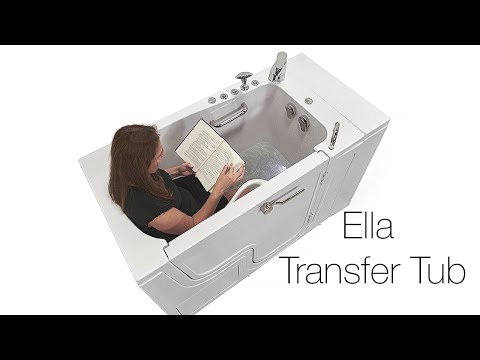
Watch: Wheelchair-Accessible Transfer Acrylic Walk-In Tub with L-Shaped Door | Ella’s Bubbles with chapters and a full transcript.
Related Guides
- What sizes do roll-in shower bases come in, and which include a seat?
- Shower Bases and Wall Panels
- What Is a Shower Dam and When Do You Need One?
Common Questions
What does roll-in shower actually mean?
Is a transfer shower the same as a Transfer walk-in tub?
How does a roll-in shower keep water in without a curb?
What sizes does the Ella roll-in shower base come in?
Can a roll-in shower have a seat as well?
How is a walk-in shower different from a roll-in shower?
About this guide. Answers in the Ella’s Bubbles Support Center are compiled from real conversations with tub owners, our technicians’ notes and the product documentation, then reviewed by our team. Tub models and options have evolved over the years, so a detail here may differ slightly from your exact tub. If something looks different on yours, send us your serial number and a specialist will confirm it for your model.
Did this solve your question?
If not, open a ticket and our team will pick it up from here.
Open a Support Ticket Videos