


What is the difference between a walk-in tub and a roll-in shower?
Updated September 2026
The difference is at the entry and in what happens once you are inside. A roll-in shower is a curb-less base with a beveled entry as low as 3/4 inch that a wheelchair or shower chair rolls straight into, with a flexible dam holding the water in; a walk-in tub is a sealed enclosure you enter through a door, sit in on a molded seat, and fill for a soak of roughly 14 to 17 1/2 inches of water with therapies, showering from the seat with the hand shower. Should I choose a walk-in tub or a roll-in shower? turns the difference into a decision; this page sets the two products side by side.
The Entry: A Lip You Roll over or a Door You Close
Ella's wheelchair accessible roll-in base is a curb-less pan. AcrylX barrier-free bases have a beveled roll-in entry of 3/4 inch to 1 1/8 inch depending on size, and SMC bases are 1 inch or 1 1/8 inch, the lowest entry of any Ella product. Because there is no curb, a collapsible rubber shower dam keeps the water in. The first video shows it installed with silicone along the front of the base, then compressing under the wheels of a chair and springing back to hold the water in the stall. For bathers who prefer a slightly raised edge and no dam, a 3 inch step-in base is offered, and Ella's one-piece and three-piece stalls have a 4 inch threshold.
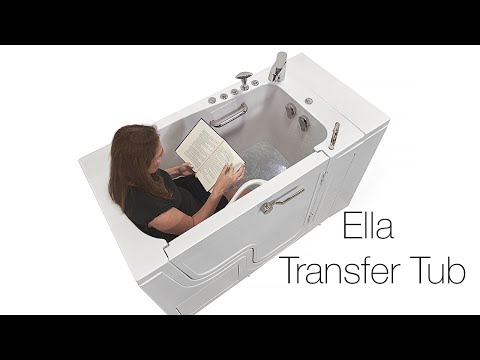
A walk-in tub has a door instead. The bather steps over the threshold, sits, and closes and locks the door before any water goes in. On the Transfer family the door is an extra wide L-shaped outward door built for wheelchair transfer; the second video shows it opening over the toilet for easy access, with a two-latch gear and shaft lock for a leak-proof seal and dual drains for fast draining. The tub gives a wheelchair user a seated soak; the roll-in base gives a wheelchair user a shower without leaving the chair.
How the Ella Options Compare
| Option | Entry or threshold | Sizes printed in the sources | Best for |
|---|---|---|---|
| AcrylX barrier-free roll-in base | Beveled roll-in entry of 3/4 inch to 1 1/8 inch depending on size | 30 x 60, 32 x 60 and 36 x 60 inches; other sizes made to order | A bather who stays in a wheelchair or shower chair and rolls straight in |
| SMC barrier-free roll-in base | 1 inch or 1 1/8 inch | not listed | A roll-in entry in the SMC seamless shower line |
| 3 inch step-in base | 3 inch step-in threshold | not listed | Someone who can step over a low edge and prefers no dam |
| One-piece and three-piece stalls | 4 inch threshold | not listed | A complete shower compartment for a bather who can step in |
| Walk-in tub, standard footprint | Door; threshold not listed | 30 by 52 inches is most common; also 32x52, 38x52, 30x60, 30x55, 28x52, 27x60 and 26x45 inches | Sitting and soaking with therapies, showering from the seat with the hand shower |
| Transfer tub | Outward L-shaped door for wheelchair transfer | 60 by 30 inches | A wheelchair user who wants a seated soak |
| TransferXXL | Outward L-shaped door for wheelchair transfer | 36 by 55 inches | A bariatric bather who needs extra width and a transfer-friendly design |
What these figures mean for your bathroom: the roll-in base wins on entry height by a wide margin, since even the 3 inch step-in base and the 4 inch stall threshold sit well above its 3/4 to 1 1/8 inch bevel, and nothing has to be crossed by a chair. The walk-in tub wins on what you can do inside, because it holds water for a soak and carries therapy packages, and the Transfer family brings the wheelchair user into that soak through a door built for the transfer. If the person bathing will stay in the chair, the base is the answer; if they can transfer to a seat and want to soak, the tub is.
What Happens Inside: A Shower or a Soak
A walk-in tub gives a molded seat and a soak, with soaking depths of roughly 14 to 17 1/2 inches on the models toured in the product videos, and therapy packages such as air massage, hydro massage, foot massage, microbubbles, chromatherapy and a heated seat. It also gives a shower: the 2-piece and 5-piece fast-fill faucets include a pull-out hand shower, and the optional shower column adds a 10 inch rain head for seated or standing showers. Walk-in Tub Model Highlights: Longer, Deluxe, Monaco, and Transfer XXL describes how the models differ in soaking style, door swing and therapy features, including the soaker, no-jets configuration.
A roll-in shower gives a standing or seated shower and nothing to fill. A seat is optional: folding benches and seats rated from 300 to 600 pounds, or a 36 by 60 base with a molded seat. Caregiver options include a weighted anti-bacterial nylon curtain, a stainless curtain rod and a slide bar with hand shower. Shower products are sold per item, so a complete roll-in shower is put together from the base, a wall system sized to it, and accessories such as grab bars or a door; Shower Bases, Walls, and Filler Pieces lists the base and wall options, including the 8 inch wide L-shaped filler piece that closes a gap to an adjoining wall.
Size and Fit in the Space You Have
The most common walk-in tub size is 30 inches wide by 52 inches long, a footprint that fits many standard tub alcoves, and cut-to-fit extension panels close a gap between the tub and the wall. The roll-in base comes in three standard sizes, 30 x 60, 32 x 60 and 36 x 60 inches, with the drain position specified when you order, and sizes outside those three can be made to order; the 32 by 60 inch barrier-free base is ready to ship in left and right configurations. Custom bases can be built to specific dimensions, such as a 36 by 36 inch corner base with the drain placed to your measurements. Walk-In Tub and Shower Base Sizes and How to Measure for Fit explains how to measure the alcove, and because the online drain-placement tool can round measurements up to the nearest inch, confirm the drain location with the team at (800) 480-6850 before a base is built.
One more term is worth separating. A walk-in shower is a shower with a low edge you step over, such as the 3 inch step-in base, and it is not the same as a walk-in tub. What is the difference between a walk-in shower and a shower stall? sorts out the shower vocabulary.

Chapters in this video
- 0:00 Introducing The Ella Shower Dam The Ella flexible shower dam is presented, highlighting its use for wheelchair users to easily roll into and out of a barrier-free shower base.
- 0:28 Installing The Shower Dam The installation process begins with measuring, cleaning surfaces, and applying the shower dam to the shower wall and floor.
- 1:25 Sealing The Shower Dam Painter's tape is applied, and a thin bead of silicone is used to seal the lower edge and end caps of the shower dam.
- 1:44 Final Result And Effectiveness The video shows the final appearance of the installed shower dam and demonstrates its effectiveness in containing water within the shower stall.
Watch: The Ella Shower Dam, Keep Water In, Roll In With Ease | Ella's Bubbles with chapters and a full transcript.
Chapters in this video
- 0:00 L-Shaped Outward Swing Door Tub Ella's Bubbles presents an L-shaped outward swing door wheelchair-accessible acrylic walk-in tub.
- 0:46 Extra-Wide L-Shaped Door The tub features an extra-wide L-shaped door that fits over the toilet and provides easy access.
- 1:07 Dual Drain Technology And Chromatherapy This tub features Ella's dual drain technology for fast draining and includes light chromatherapy for a relaxing visual element.
- 1:23 Optional Heated Seat And Shower An optional heated seat and backrest add comfort, and the tub is available with a four-fold glass screen or a walk-in tub shower column.
Watch: Wheelchair-Accessible Transfer Acrylic Walk-In Tub with L-Shaped Door | Ella’s Bubbles with chapters and a full transcript.
Related Guides
- What is a roll-in shower and who is it designed for?
- What Is the Difference Between a Roll-In Shower and a Walk-In Shower?
- Installing Ella Shower Bases, the Flexible Shower Dam, and Shower Walls
Related Videos

Common Questions
Is a Transfer tub the same thing as a roll-in shower?
Can I shower in a walk-in tub instead of a roll-in shower?
Does a roll-in shower come with a seat?
What keeps water inside a roll-in shower with no curb?
How low is the entry on a roll-in shower base?
Which one fits in a standard bathtub alcove?
About this guide. Answers in the Ella’s Bubbles Support Center are compiled from real conversations with tub owners, our technicians’ notes and the product documentation, then reviewed by our team. Tub models and options have evolved over the years, so a detail here may differ slightly from your exact tub. If something looks different on yours, send us your serial number and a specialist will confirm it for your model.
Did this solve your question?
If not, open a ticket and our team will pick it up from here.
Open a Support Ticket Videos