


What is an accessible tub and who needs one?
Mis à jour Novembre 2026
An accessible tub is a bathtub built so that a person with limited mobility can get in, sit down, bathe and get out without climbing over a high tub wall. It replaces the wall with a low step-in threshold and a sealed, hinged door, and it adds a molded seat so you bathe sitting upright rather than lowering yourself to the floor of the tub. Every Ella's Bubbles walk-in tub is accessible in that sense, and the Transfer family goes a step further with an extra-wide L-shaped outward door for bathers who slide across from a wheelchair, as How do I choose a wheelchair accessible walk-in tub? explains. The people who need one are those for whom stepping over a conventional tub has become difficult, unsafe or impossible, whether they walk in on their own, bathe with a caregiver, or transfer from a chair.
What Makes a Bathtub Accessible
A conventional bathtub asks you to lift one leg over the rim, balance on the other, and then lower yourself to the bottom. An accessible tub removes each of those moves. On an Ella walk-in tub the entry is a low threshold, 3.5 inches on the Capri for example, closed by a door that seals against the water once you are inside. A molded seat at 17 inches on most models means you sit at roughly chair height and the water rises around you, instead of you sinking to the floor and climbing back up. The door itself comes in several styles, and the style decides how you enter:
- Inward swing brushed stainless steel door with frosted tempered glass. The door is detachable, which makes the hard-to-reach places behind it easier to clean.
- Outward swing U-shape door made from high impact composite with a decorative tempered glass screen. It closes with three latches on Ella's gear and shaft mechanism, which pulls the door tight for a leak-proof seal.
- L-shaped outward swing door, made of durable yet lightweight aluminum, with two latches on the same gear and shaft mechanism. This is the door on the Transfer models, and its opening leaves no sidewall beside the seat.
Because an outward door opens into the room, confirm the clear floor space in front of the tub with your installer before you order. The model highlights note that both in-swing and out-swing doors are available depending on the model, so the door is one of the first choices to settle.
Who Needs an Accessible Tub
The clearest way to decide is to start with the bather, not the bathroom. Ella's accessible bathroom guide sorts people into four situations, and each one points to a different product.
- The bather walks in and can sit down. A seated walk-in tub is usually the best fit. It gives a safe entry plus a seated soak and optional massage therapy that a shower cannot offer.
- The bather transfers from a wheelchair to a seat. The Transfer family of walk-in tubs has a wide L-shape door built for seated transfers, and the Transfer60 is the model named as wheelchair accessible in the lineup comparison.
- The bather stays in a wheelchair or shower chair. A tub is not the right answer here. A curbless roll-in shower base has no lip to lift a wheel over, and that is the better choice.
- The bather bathes with a caregiver alongside. A walk-in shower, especially a curbless base, leaves room for the caregiver to help. Which walk-in shower is best for an accessible bathroom? compares those shower options.
In short, an accessible tub is for the person who can still sit and stand, with or without help, but can no longer manage a high tub wall safely. If the person cannot leave the chair at all, the accessible answer is a shower rather than a tub.
Accessible Tubs and Entries Compared
The table uses only figures published in Ella's current guides. Where a figure is not published in them, the cell says not listed.
| Option | Size, seat and entry figures | Best for |
|---|---|---|
| Seated walk-in tub (Capri as example) | 3.5 inch step-in threshold; 17 inch seat height on most models | A bather who steps in, sits upright and wants a soak or massage therapy |
| Transfer26 | 26 x 52 x 40 inches; 19 inch wide seat; 75 gallons unoccupied, 35 to 55 gallons occupied | Petite to average bathers and bathrooms where a wider tub will not fit |
| Transfer30 | Size not listed; 22 inch seat | The mid-width wheelchair accessible model |
| Transfer32 | 32 x 52 x 40 inches; 24 inch wide molded seat; 107 gallons unoccupied, 45 to 65 gallons occupied | Larger body types who want more hip room inside a 52 inch footprint |
| Transfer60 | Size and seat not listed | The model named as wheelchair accessible in the lineup comparison |
| TransferXXL | 36 x 55 inches; seat not listed | Bariatric bathers who need extra width and a transfer-friendly design |
| Curbless roll-in shower base | 30 x 60, 32 x 60 and 36 x 60 inches; no threshold | A bather who stays in a wheelchair or shower chair |
What the differences mean is simple. A seated walk-in tub keeps a small lip at the entry and asks the bather to step over it, so it suits someone who can stand briefly. The Transfer models remove the sidewall beside the seat so the bather never has to stand, and the width you choose is really a choice of hip room on the seat, from 19 inches on the Transfer26 to 24 inches on the Transfer32. The roll-in shower removes the lip entirely but gives up the seated soak. The full lineup comparison covers the other models, including two-seater tubs, if more than one person will use the bathroom.
How the L-Shaped Door Changes the Transfer
The first video walks through Ella's door styles and shows why the L-shaped door suits a wheelchair user. Because the opening has no sidewall beside the seat, you slide straight across from the chair onto the seat. The L-shaped opening also allows toilet clearance of up to 21 inches in height, so the door can swing out over a toilet that sits beside the tub, and it leaves convenient space for the wheelchair itself. The second video shows a Transfer tub in use: the extra-wide door fitting over the toilet, the two-latch gear and shaft lock closing for a tight seal, and the dual drains that empty the tub quickly. On the Transfer32 the door opens to 172 degrees, with a 20 inch swing clearance called out on the drawing, which is the figure your installer needs when checking the floor space in front of the tub.
Accessible Is Not the Same as ADA Compliant
Shoppers often use accessible and ADA compliant as if they were one thing, and they are not. The Americans with Disabilities Act accessibility standards apply to public accommodations and commercial facilities, and compliance is judged on the whole installation, including compartment dimensions, threshold height, the seat, grab bar placement and the reach range for controls. One accessible feature does not make a fixture compliant. Ella's shower stalls, for instance, are built as accessible residential showers but are not ADA compliant, as Are Ella Shower Stalls ADA Compliant? explains. For a private home, ADA certification is generally not a building code requirement, and most families choose an accessible tub for what it does day to day. For a commercial building or any project that will be inspected against the standard, confirm the requirement with your local code official before you order.
Planning the Room Around an Accessible Tub
A few practical points follow from the choice of an accessible tub, and settling them early avoids surprises on delivery day.
- Fit the alcove. The 52 inch Transfer models include an 8 inch extension panel so they finish neatly inside a standard 60 inch alcove.
- Plan the path into the home around the crate, not the tub. The Transfer26 ships at 300 pounds in a 29 by 60 by 50 inch crate, and the Transfer32 at 373 pounds in a 35 by 55 by 50 inch crate.
- Check the swing. Every Transfer door and every U-shape door opens outward, so measure the clear floor in front of the tub and the position of the toilet with your installer.
- Choose the therapy package. Every Transfer model can be ordered as a soaking tub with no jets or with therapy. Across the lineup, options can include a heated seat and back, hydro jets, air jets, microbubbles and hydrofoot therapy, and the second video shows the independent foot massage running from its own pump and intensity dial without filling the whole tub.
- Add the comfort items. Depending on the model, you can add a 24 inch hand shower slide bar or a 10 by 7.5 inch head pillow, and the Transfer tub in the video is shown with a four-fold glass screen and a shower column with a hand shower and rain shower head.
Your Ella dealer or the team at (800) 480-6850 can match a model to your measurements and to the way the bather gets in.

Chapters in this video
- 0:00 Ella's Walk-In Tub Door Styles Ella's Bubbles offers three distinct walk-in tub door styles: stainless steel, acrylic outward swing, and aluminum L-shaped outward swing.
- 0:22 Stainless Steel Door Features The detachable stainless steel door makes cleaning hard-to-reach places in your walk-in tub much easier.
- 0:50 L-Shaped Door Accessibility The L-shaped door opening provides convenient space for wheelchair access and toilet clearance up to 21 inches in height.
Watch: Wheelchair Accessible Walk-In Tub Door Options for Elderly & Disabled | Ella’s Bubbles with chapters and a full transcript.
Related Videos

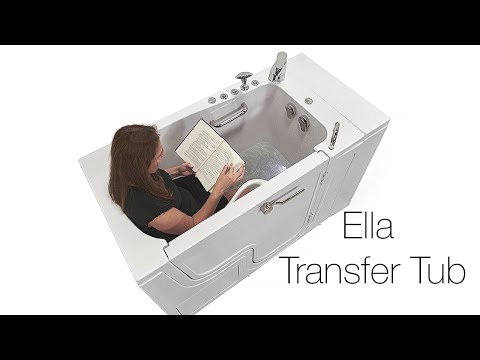
Chapters in this video
- 0:00 Porte à ouverture vers l'extérieur en forme de L Tub Ella's Bubbles presents an L-shaped outward swing door wheelchair-accessible acrylic walk-in tub.
- 0:46 Extra-Wide L-Shaped Door The tub features an extra-wide L-shaped door that fits over the toilet and provides easy access.
- 1:07 Technologie double vidange And Chromatherapy This tub features Ella's dual drain technology for fast draining and includes light chromatherapy for a relaxing visual element.
- 1:23 Optional Heated Seat And Shower An optional heated seat and backrest add comfort, and the tub is available with a four-fold glass screen or a walk-in tub shower column.
Questions fréquentes
Is every Ella walk-in tub considered an accessible tub?
Which Ella tubs are wheelchair accessible?
Does an accessible walk-in tub fit over the toilet?
Is an accessible tub the same as an ADA compliant tub?
Who should choose a shower instead of an accessible tub?
About this guide. Answers in the Ella’s Bubbles Support Center are compiled from real conversations with tub owners, our technicians’ notes and the product documentation, then reviewed by our team. Tub models and options have evolved over the years, so a detail here may differ slightly from your exact tub. If something looks different on yours, send us your serial number and a specialist will confirm it for your model.
Did this solve your question?
Sinon, ouvrez un ticket et notre équipe prendra le relais.
Ouvrir un ticket d'assistance Vidéos